
One Blade for Birds

Paint one blade of a wind turbine black,and birds may be able to see the rotor in time to avoid a collision.

One Blade for Birds calls on wind farm operators to paint one blade of their turbines black, so that birds can see the rotor in time. Each day, Pengpeng Qu writes to one operator, proposing a pilot that starts with just one black blade. Others are invited to join in: the broader the participation, the more likely operators are to agree.

One letter, one blade, one bird.

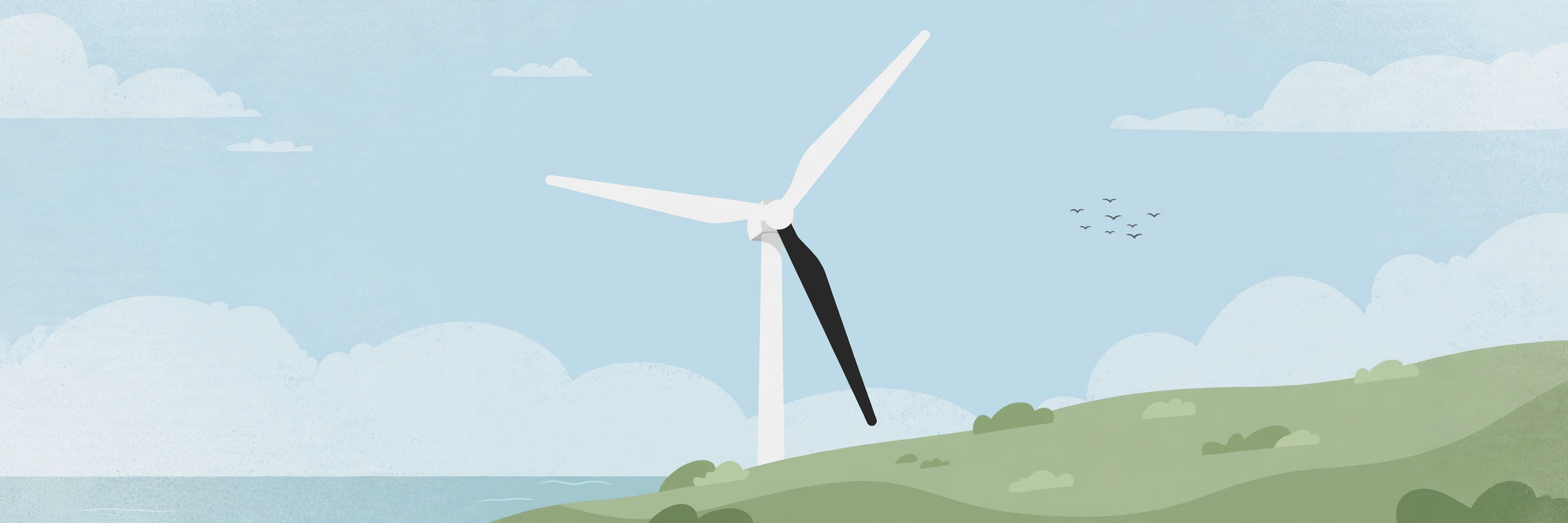
Illustration of a wind turbine on a green coastal hill: two of its three blades are white, and one blade is painted black. A small flock of birds flies in the distance.
One black blade among three — the whole idea, in one picture.

The idea

Wind power is essential, and it has a cost: birds die when they fly into spinning turbine blades. Part of the problem may be how birds see. A fast-spinning rotor blurs into a faint, translucent disc — an effect researchers call motion smear. To a bird, the blades can nearly disappear until it is too late to turn.

Painting just one of the three blades black breaks up that blur. Instead of an invisible disc, the bird sees a moving pattern it can recognize as a solid, turning object — and steer around.

It is a strikingly simple idea: no new machinery, no shutdowns, just paint on one blade out of three. The question is whether it actually works — and the honest answer is: sometimes, in the places tested so far, and not everywhere. That is what the science section below is for.


The science — all of it

Three field experiments have tested the black blade so far. Two found large reductions in bird deaths; one found no effect at all. All three are summarized here, including the parts that argue against the idea.

Smøla, Norway

Published 2020 · 10-year experiment
−71.9%

At the Smøla wind farm, researchers painted one blade black on four turbines in 2013 and compared bird fatalities before and after, against four neighbouring unpainted turbines (a before–after–control–impact design, with carcass searches over 7½ years before painting and 3½ years after). The annual fatality rate at the painted turbines fell by an average of 71.9% relative to the controls. The effect was strongest for raptors: six white-tailed eagles were found dead at the to-be-painted turbines before painting, and none afterwards.

Its limits: only four painted turbines at a single coastal site, chosen because birds had already died there. The authors themselves say the result needs to be repeated elsewhere before it can be generalized.

May, R., Nygård, T., Falkdalen, U., Åström, J., Hamre, Ø. & Stokke, B. G. (2020). “Paint it black: Efficacy of increased wind turbine rotor blade visibility to reduce avian fatalities.” Ecology and Evolution, 10(16), 8927–8935. doi.org/10.1002/ece3.6592
El Ruedo, Spain

Published 2026 · 13-year experiment
−74%

At El Ruedo, near the Strait of Gibraltar — one of the world’s great bird migration crossings — one blade was painted black on four of the farm’s twenty turbines. Teams searched for dead birds under the turbines every day for 9½ years before painting and 3½ years after. Fatality rates at the painted turbines fell by 74% relative to the sixteen unpainted control turbines. The benefit was largest for songbirds (passerines) and large waterbirds such as herons and storks.

Its limits: again only four painted turbines at one site, with relatively small turbines (0.8 MW). Notably, this study found no significant reduction for birds of prey — almost the opposite pattern from Smøla — and the researchers ran no trials to measure how many carcasses searchers miss or scavengers remove.

May, R., Hernández Gómez, M. Á., Aguirre Martínez, J. L. & Andreu Miguel, J. (2026). “Efficacy of Painting Wind Turbine Blades as a Mitigation Measure to Reduce Bird Collisions in a Mediterranean Wind Farm.” Ecology and Evolution, 16(9), e74017. doi.org/10.1002/ece3.74017

Eemshaven, Netherlands

Reported 2025 · 3-year monitoring
No significant effect

At the Eemshaven wind farm, seven of fourteen turbines received one black blade, with one baseline year and two years of monitoring afterwards. Researchers found 436 collision victims in total — and no statistically significant difference between painted and unpainted turbines, for all birds combined or for any species group tested. A companion study of flight behaviour near the turbines also found no difference in how birds flew around painted versus unpainted turbines. One possible explanation the researchers raise: against Eemshaven's busy industrial port backdrop, a black blade may simply not stand out enough. If contrast is what matters, that leaves an open question: where black blends in, would a different high-contrast colour — red, for example — stand out? No trial has tested a red blade, so the question is unanswered, not a finding.

Why it matters: this trial found more than ten times as many collision victims as the Smøla study, so its “no effect” result is statistically sturdy, not a fluke of small numbers. The black blade is not a universal fix — site, landscape, and species clearly matter.

Kleyheeg-Hartman, J. et al. (2025). Onderzoek ‘zwarte wiek’ Eemshaven (Black blade research, Eemshaven). Waardenburg Ecology. Summary: waardenburg.eco


The ask: a pilot, not a mandate

Please try it on one to four turbines, and measure what happens.

That is the whole request. Not a fleet-wide repaint, not a new rule — a small, reversible pilot: paint one blade black on a handful of turbines, monitor bird collisions there (and at similar unpainted turbines) for a reasonable period, and let the results speak.

If it works at your site, you will have the numbers to justify doing more. If it doesn’t, that is valuable knowledge too — and this project will publish it either way.


How the daily letters work

  1. One letter a day

    Every day, one letter goes to one organization connected to wind energy — an operator, a developer, a manufacturer, a regulator, an industry or conservation group — in Canada, the United States, or anywhere in the world.

  2. Written for each company

    Before writing, the company is researched — its background, its sites, and the birds that pass through its region. Each letter is then written for that company, with a suggestion made for them — not a form letter with one line changed.

  3. Everything is published

    Each letter, and every reply received, is posted here and on Instagram. Agreements, refusals, and silence all stay on the record.

  4. A project that never ends

    This project never ends. The letters keep going — for as long as it takes, for the birds — each one a small chance that somewhere, a few turbines get one black blade and a careful count.


The letter

Dear Sir or Madam,

My name is Pengpeng Qu, and I am a high school student who cares about birds — and about the clean energy we need. I am writing to ask you to consider a small experiment: painting one blade black on one to four of your turbines, and monitoring bird collisions there to see what changes.

[One sentence written for this organization — about its site, its region, or the birds that pass through it.]

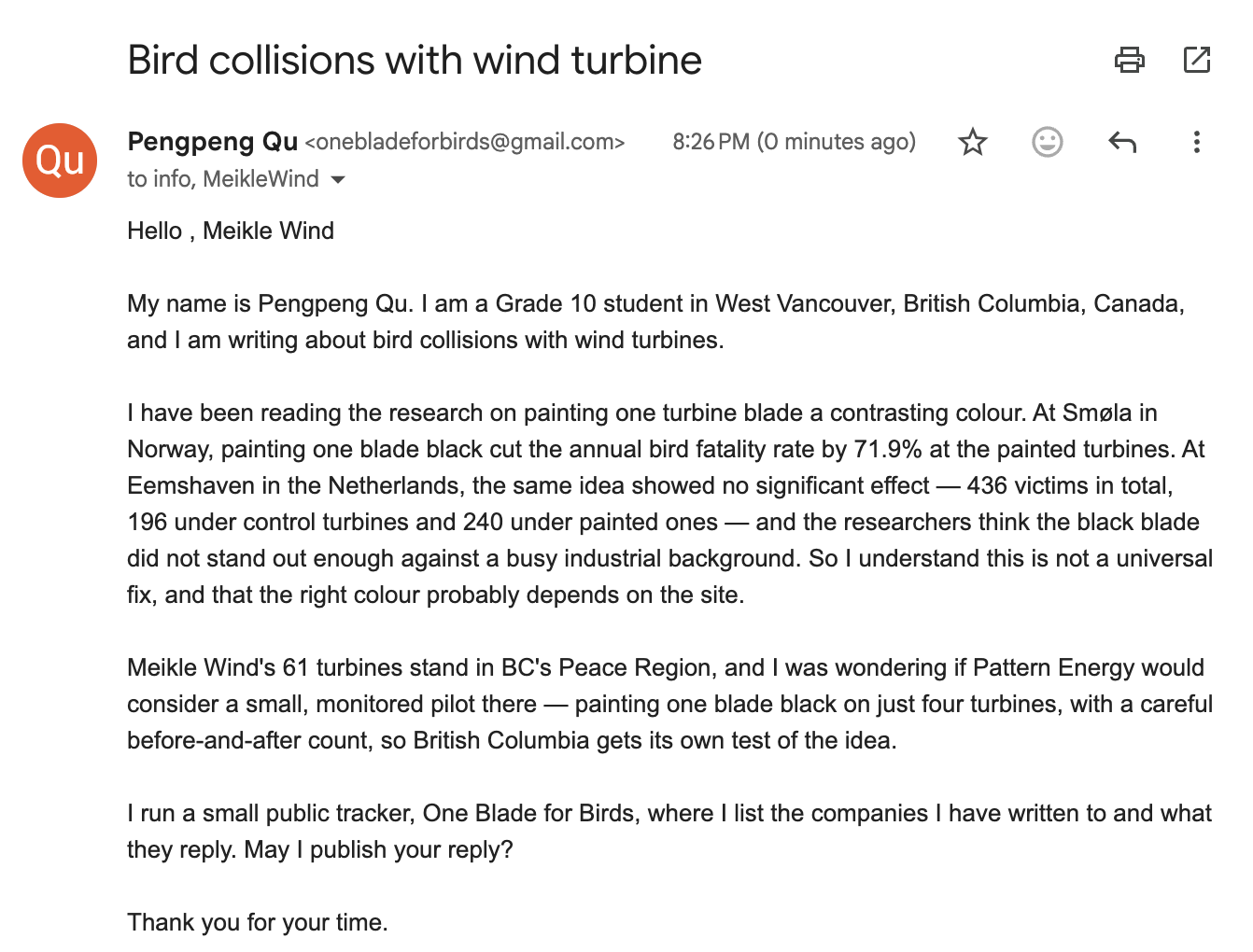
The idea comes from peer-reviewed research. At the Smøla wind farm in Norway, painting one of three blades black was followed by a 71.9% reduction in recorded bird fatalities at the painted turbines (May et al., 2020). A longer study at El Ruedo in Spain found a similar reduction of about 74% (May et al., 2026). In the interest of honesty, I should add that a trial at Eemshaven in the Netherlands found no significant effect — which is exactly why I am asking for a monitored pilot rather than a fleet-wide change. A pilot would show whether it works at your site, with your birds.

I am writing to one organization each day, and I publish every letter and every reply I receive, so the results — good, bad, or none — are on the record. I would be grateful for any response, even a brief one.

Thank you very much for your time, and for the work you do.

Sincerely,
Pengpeng Qu
High school student

Free to reuse — if you write your own version, please keep the science honest.

Letter log

Sending now — updated daily

Sending began today, Wednesday, November 25, 2026. One letter goes out every day, and this log is updated daily — each entry shows the date, the recipient, the subject, and any reply that comes back. Open an entry to read the full letter and see the email as it was sent.

Nothing will be added to this log that didn’t actually happen.


Follow along

The project will also post daily updates on Instagram — each letter as it goes out, and each reply as it arrives. The Instagram link will be added here as soon as the account is live.


Contact us

Questions, ideas, or a reply to one of the letters? Write to us at onebladeforbirds@gmail.com.